EBITDA Calculator

ebita image 2

EBITDA Calculator

Calculate EBITDA quickly to evaluate operational performance, improve financial strategy, and measure true business profitability

EBITDA Calculator

Enter your figures to calculate estimated EBITDA.

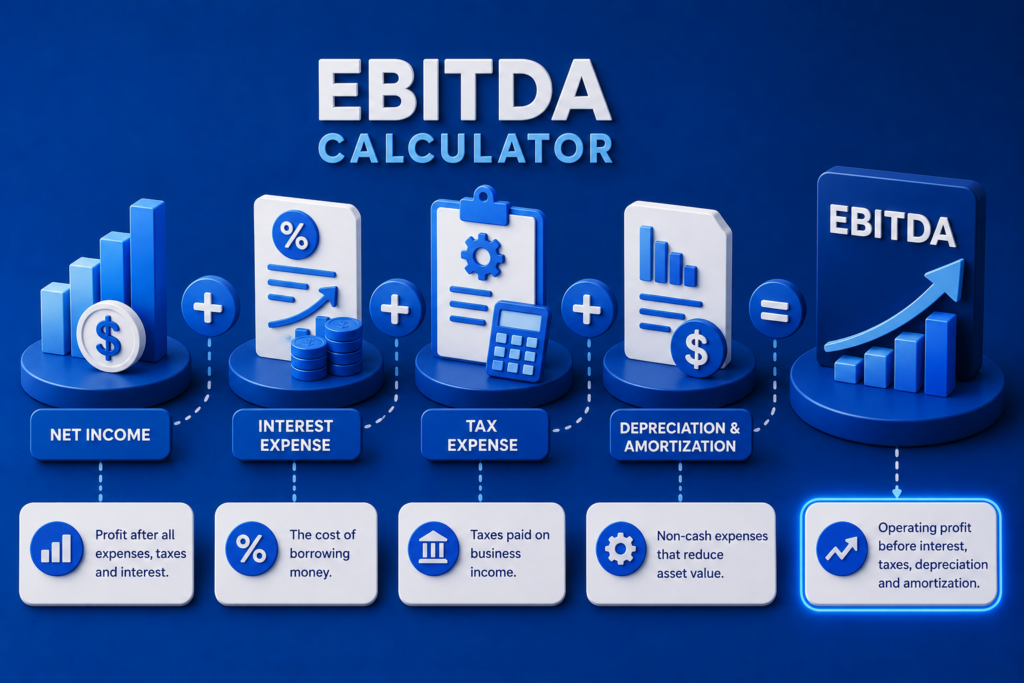
Formula: Net Income + Interest + Taxes + Depreciation + Amortization = EBITDA

EBITDA Results

View your estimated EBITDA and visual breakdown.

Estimated EBITDA $0
Net Income
$0
Interest
$0
Taxes
$0
Depreciation
$0
Amortization
$0
Total EBITDA
$0

EBITDA Formula Explained

EBITDA stands for Earnings Before Interest, Taxes, Depreciation, and Amortization. It measures a company’s core operational profitability by focusing on earnings generated strictly from business operations before financial and accounting deductions. EBITDA helps business owners, investors, and financial analysts evaluate performance without the distortion of financing structures, tax environments, or non-cash expenses.

Measures Operational Profitability

Helps Compare Companies Fairly

Useful for Investors and Lenders

Assists with Valuations

Tracks Financial Efficiency

Supports Growth Planning

Why EBITDA Matters for Financial Decision-Making

EBITDA vs EBITA vs EBIT vs Net Income

EBITDA

Excludes interest, taxes, depreciation, and amortization

EBITA

Excludes interest, taxes, depreciation, and amortization

EBIT

Excludes interest and taxes

Net Income

Final profit after all expenses

2026 EBITDA Margin Benchmarks by Industry

SaaS 30%
Professional Services 28%
Healthcare 20%
Manufacturing 15%
Construction 14%
Restaurants 13%
Retail 10%

Disclaimer:  Benchmarks vary based on company size, market conditions, and geography.

7 Strategies to Improve EBITDA Performance

1. Increase Revenue
– Upsell
– Improve pricing
– Expand services

2. Reduce Operating Costs
– Streamline workflows
– Negotiate vendors

3. Improve Gross Margins
– Lower COGS
– Raise strategic prices

4. Automate Operations
– Reduce labor inefficiencies

5. Manage Debt Wisely
– Lower interest burdens

6. Eliminate Unnecessary Expenses
– Review recurring costs

7. Focus on High-Margin Services-
– Prioritize profitability

Your EBITDA Frequently Asked Questions

A good EBITDA margin varies by industry, but generally:

  • Below 10% = Lower profitability
  • 10–20% = Healthy
  • 20%+ = Strong

Industries like SaaS or professional services often achieve higher margins, while retail or hospitality may operate with lower margins.

No. EBITDA measures operational profitability before certain expenses, while cash flow reflects actual money moving in and out of a business. EBITDA excludes working capital changes, capital expenditures, and debt obligations.

Investors use EBITDA because it provides a clearer picture of a company’s operating performance by removing variables like financing decisions, tax environments, and accounting practices. This makes it easier to compare businesses objectively.

Yes. Negative EBITDA indicates a company’s operating expenses exceed its revenue, signaling operational losses before accounting for taxes, interest, and non-cash expenses.

EBITDA should ideally be tracked monthly, quarterly, and annually. Regular monitoring helps business owners identify trends, improve profitability, and make proactive financial decisions.

EBITDA is commonly used in:

  • SaaS
  • Manufacturing
  • Healthcare
  • Construction
  • Professional services
  • Private equity
  • Mergers & acquisitions

These industries often use EBITDA for performance analysis, valuations, and investment decisions.

It depends. In small businesses, owner salary may be included as an operating expense, but adjusted EBITDA often adds back owner compensation to provide a clearer view of true operational profitability.

Book Financial Strategy Session

Get expert support and clarity, without the stress.