
Should You Incorporate Your Business in Ontario?
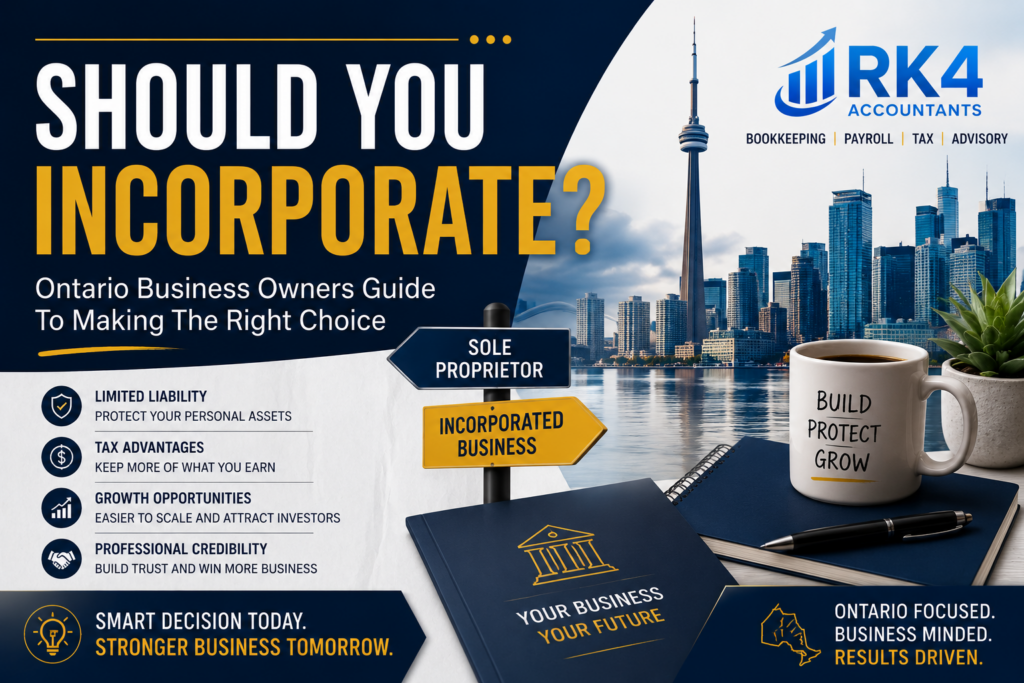
One of the most common questions entrepreneurs ask is whether they should operate as a sole proprietor or incorporate their business.
While incorporation offers several advantages, it isn’t the right solution for every business owner. The decision depends on factors such as income levels, growth plans, liability concerns, and long-term financial goals.
Understanding the benefits and considerations of incorporation can help you make an informed decision that supports your business’s future success.
What Does It Mean to Incorporate?
When you incorporate a business, you create a separate legal entity that exists independently from its owners.
The corporation can:
- Earn income
- Own assets
- Enter contracts
- Borrow money
- Hire employees
Because the corporation is a separate legal entity, it can provide certain protections and tax planning opportunities that are not available to sole proprietors.
Sole Proprietorship vs. Corporation
Before deciding whether to incorporate, it’s important to understand the difference between these business structures.
Sole Proprietorship
A sole proprietorship is the simplest business structure.
Advantages include:
- Easy setup
- Lower startup costs
- Simplified administration
- Fewer filing requirements
However, the owner and business are considered the same legal entity.
This means the owner is personally responsible for business debts and obligations.
Corporation
A corporation is a separate legal entity.
Advantages may include:
- Limited liability protection
- Tax planning opportunities
- Greater credibility
- Easier access to financing
- Potential income-splitting opportunities (where permitted)
However, corporations also involve additional administrative and compliance requirements.
1. Liability Protection
One of the most significant benefits of incorporation is limited liability protection.
In general, the corporation becomes responsible for its own obligations and liabilities.
This can help protect personal assets such as:
- Personal savings
- Investments
- Personal property
While incorporation does not eliminate all personal liability, it often provides a valuable layer of protection.
Incorporation May Be Worth Considering If:
- You work with large contracts
- You provide professional services
- You employ staff
- You face potential legal risks
2. Tax Deferral Opportunities
Corporations often provide tax advantages when profits are retained within the business.
In many cases, corporate tax rates are lower than personal tax rates.
This allows business owners to:
- Leave funds in the corporation
- Reinvest profits
- Support future growth
The ability to defer personal taxation can be a significant benefit for growing businesses.
3. Business Growth and Expansion
Businesses planning for growth often benefit from incorporation.
A corporation can make it easier to:
- Add shareholders
- Raise capital
- Bring on investors
- Expand operations
- Transfer ownership
As businesses become more complex, the corporate structure often provides greater flexibility.
4. Professional Image and Credibility
Many customers, suppliers, and lenders view incorporated businesses as more established and professional.
Incorporation may help improve credibility when:
- Applying for financing
- Negotiating contracts
- Pursuing larger clients
- Building strategic partnerships
While credibility alone shouldn’t drive the decision, it can provide an advantage in competitive industries.
5. Income Splitting Opportunities
Although tax rules have become more restrictive, certain opportunities may still exist to distribute income among family members under specific circumstances.
Professional tax advice is important to ensure compliance with current legislation.
When Incorporation May Not Make Sense
Incorporation isn’t always the best choice.
You may choose to remain a sole proprietor if:
- Your business is in its early stages
- Profits are relatively low
- You need simplicity
- You plan to withdraw all business earnings personally
For some business owners, the additional compliance requirements may outweigh the benefits.
Costs and Responsibilities of Incorporation
Incorporated businesses have additional obligations.
These may include:
- Corporate tax returns
- Annual filings
- Payroll administration
- Bookkeeping requirements
- Corporate record maintenance
- Minute book updates
Business owners should be prepared to meet these ongoing responsibilities.
Signs You Should Consider Incorporating
You may want to explore incorporation if:
- Your business is consistently profitable
- You don’t need all profits for personal living expenses
- You’re concerned about liability
- You plan to hire employees
- You expect significant business growth
- You’re seeking financing opportunities
These factors often indicate that incorporation may provide meaningful benefits.
Common Misconceptions About Incorporation
"Incorporation Eliminates All Liability"
While incorporation can provide protection, directors and shareholders may still have personal responsibilities in certain situations.
"Incorporation Always Saves Taxes"
Tax savings depend on the specific circumstances of the business and owner.
Incorporation should be evaluated as part of a broader business and tax strategy.
"Incorporation Is Only for Large Businesses"
Many small businesses benefit from incorporation, particularly when profitability and growth potential increase.
How RK4 Accountants Can Help
At RK4 Accountants, we help entrepreneurs evaluate whether incorporation makes sense for their specific situation.
Our Business Launch Services include:
- Corporation registration
- CRA business number setup
- HST registration
- Accounting software setup
- Payroll setup
- Ongoing bookkeeping and compliance support
We help business owners build a strong foundation from day one.
Final Thoughts
The decision to incorporate should be based on your business goals, profitability, liability exposure, and future plans.
For many growing businesses, incorporation can provide valuable legal protection, tax planning opportunities, and greater flexibility for expansion.
However, every business is unique, and the right choice depends on your specific circumstances.
Thinking About Incorporating?
Book a Free Financial Review with RK4 Accountants and learn whether incorporation is the right next step for your business.